L’une des recommandations pour prévenir la maladie d’Alzheimer est de faire travailler sa mémoire. La réserve cognitive est un concept affirmant que notre cerveau peut faire face et même réparer les lésions qu’il subit. Il nous est dit que les activités qui vont stimuler notre cerveau lui permettront d’entretenir cette réserve. Les réseaux neuronaux ainsi consolidés deviendraient plus efficaces et compenseraient les réseaux en mauvais état. Ainsi, la réserve cognitive retarderait l’arrivée des premiers symptômes d’Alzheimer.
Parmi les activités recommandées pour faire travailler notre mémoire, le jeu figure en bonne place aux côtés de la lecture, d’activités créatives comme la peinture, le bricolage. Les spécialistes nous recommandent aussi de voyager, car la nouveauté stimule notre cerveau.
Lorsque nous avons lu ces recommandations, une idée à rapidement germé dans notre esprit à savoir combiner nouveauté et jeu. Pourquoi ne pas nous essayer à des jeux que nous ne connaissons que de nom. Les jeux de cartes figurants dans la liste des jeux conseillés, la solution qui s’est immédiatement imposé était de nous essayer aux jeux de casino et plus particulièrement aux sites de jeux en ligne comme ceux qui nous sont proposés par dépôt 5$ casino. Nous ferions ainsi d’une pierre trois coups, car l’apprentissage de l’outil informatique fait lui aussi partie des activités recommandées pour faire travailler notre mémoire.
Avantages
L’inconvénient des jeux de cartes joués de façon traditionnelle, mis à part les patiences ou solitaires, est que vous avez besoin d’autres joueurs pour pouvoir y jouer. Vous ne pouvez donc pas y jouer lorsque vous en avez envie, mais lorsque l’heure convient aussi à vos partenaires de jeu. De plus, il suffit qu’un seul joueur se désiste, alors qu’il faut être 4 pour pouvoir jouer, pour annuler votre séance de jeu. À l’opposé, lorsque vous jouez en ligne les versions numériques des jeux ont été conçues pour vous permettre d’y jouer seul.
De plus, il existe de nombreux sites où vous trouverez des joueurs disponibles à toute heure du jour et de la nuit. Tout au plus, vous devrez réserver une place pour une partie, le temps que d’autres joueurs s’inscrivent. Cela prend au maximum 30 minutes. Internet abolit le temps et l’espace. Imaginons qu’il soit 2 heures du matin au Canada, trouver des partenaires de jeux ne sera pas simple. Mais, à Hong Kong il est 15 h et en France 8 h. Par conséquent, il sera facile de rencontrer des joueurs d’autres pays comme Hong Kong ou la France sur un site de jeu en ligne qui seront disponibles pour jouer.
Sur les sites de casinos en ligne vous pouvez jouer au Poker, au Blackjack, au Baccarat, à Dragon Tiger ainsi qu’au Hi-Lo. Il s’agit de jeux où la mémoire est mise à contribution ainsi que vos aptitudes au calcul mental.
Un dernier point à connaître est qu’il est recommandé de jouer à des jeux différents et non à un seul. Généralement, lorsqu’on joue uniquement avec ses amis, on joue toujours au même jeu. À la longue la mémoire ne sera pas autant stimulée qu’elle pourrait l’être, car l’habitude engendre des réactions réflexes. Pour nous, les sites de casino en ligne qui offrent des jeux différents sont parfaits pour cela.
Le donépézil (Aricept) est prescrit dans le traitement symptomatique des formes légères à modérément sévères de la maladie d’Alzheimer.
Le donépézil ne soigne pas la maladie d’Alzheimer, mais il peut aider à ralentir la progression des symptômes.
Aricept , également connu sous le nom de Donezepil, ne ralentit pas la progression de la maladie dans le cerveau, mais il peut ralentir davantage le déclin de la cognition, généralement pendant environ six mois. Aricept était le deuxième médicament approuvé dans la maladie d’Alzheimer.
Comment fonctionne le donépézil ?
Il existe un faisceau de neurones qui se projettent dans deux structures du cerveau : le cortex et l’hippocampe; appelé ‘la voie cholinergique neuronale’.
En effet, les neurones libèrent un neurotransmetteur: l’acétylcholine qui joue un rôle prépondérant dans l’apprentissage et la mémoire.
La destruction progressive de cette voie cholinergique entraîne la
diminution de production d’acétylcholine qui est très vraisemblablement la
cause des symptômes observés dans la maladie d’Alzheimer (perte de mémoire, perte
de l’orientation…).
Le donépézil augmente la libération d’acétylcholine en bloquant l’action de l’acétylcholinestérase, une enzyme qui dégrade l’acétylcholine libérée par les neurones.
Ceci entraîne une augmentation dans la fente synaptique de la concentration d’acétylcholine et l’augmentation de la transmission cholinergique.
On dit que le donepezil est un inhibiteur de l’acétylcholinestérase.
L’augmentation d’acétylcholine dans le cerveau est sensée être
responsable de l’amélioration des symptômes observée après un traitement au
donepezil.
Maladie d’Alzheimer (stade léger à modéré)
Les
données évaluant l’efficacité du donépézil dans le traitement de la maladie
d’Alzheimer (au stade léger à modérément sévère) proviennent à ce jour de 24
essais cliniques. Ces essais cliniques randomisées en double aveugle contre
placebo ont été d’une durée de 3 à 13 mois.
Ces
résultats (comparés au groupe placebo) ont montré que le donépézil (5 à 10
mg/jour) a des effets bénéfiques se traduisant par une amélioration, une
stabilisation ou un retard du déclin des domaines suivants:
– Impression clinique globale,
– performance cognitive et, dans une moindre mesure,
– activités de la vie quotidienne,
– comportement.
Les
résultats cliniques ayant évalué l’effet du donépézil sur les activités de la
vie quotidienne et le comportement sont moins solides. Selon la Commission de
la Transparence de la Haute Autorité de Santé (France), environ un tiers des
patients tirent un bénéfice du traitement.
Malgré un rapport efficacité/effets indésirables modeste, la Commission considère que le Service Médical Rendu de ce médicament reste important (niveau II).
Une équipe de chercheurs a étudié l’efficacité du donépezil sur des patients souffrant de la forme sévère de la maladie d’Alzheimer.
Caractéristiques
de l’étude : Les auteurs de sont basés sur quatre études cliniques incluant 904
patients traités pendant 24 semaines. Le Severe Impairment Battery (SIB) a été
utilisé pour mesurer l’état cognitif global et évaluer les différentes
fonctions cognitives (attention, mémoire, orientation, langage, capacités
visuo-spatiales et constructives, interactions sociales).
Résultats:
le donépezil a un effet bénéfique sur le fonctionnement cognitif de cette
catégorie de patients, comparé au groupe placebo. Il existe un différence
statistiquement significative selon l’échelle SIB (6.22 points de différence
entre les deux groupes).
Sept des
neuf domaines cognitifs évalués par l’échelle SIB sont améliorés chez les
patients traités au donépezil, par rapport au groupe placebo. Cette
amélioration s’accompagne d’une amélioration des activités de la vie
quotidienne. Source : J Alzheimers Dis. 2010; 21: 843-851.
Effet
très modeste
Cette
étude indique que le déclin cognitif des patients Alzheimer, au stade modéré ou
sévère, était plus faible lorsque ces derniers prenaient du donépézil depuis au
moins 3 mois, comparé à ceux qui n’en prenaient pas. L’effet bénéfique du
médicament était plus significatif lorsque les symptômes étaient moins marqués
au début de l’étude.
Cependant,
ces résultats sont à analyser avec prudence pour deux raisons :
1. L’effet
bénéfique de l’Aricept est faible.
2. Certains patients dont on soupçonnait de ne pas bien prendre leurs médicaments, ont été exclus de l’étude.
Les auteurs ont déclaré des conflits d’intérêts pour avoir reçu des paiements des compagnies pharmaceutiques (Eisai et Pfizer) qui ont développé l’Aricept.
Alzheimer : le donépézil est-il le médicament le plus efficace ?
Le donépezil (Aricept) semble être le médicament le plus efficace pour améliorer la cognition (mémoire, concentration, vigilance) et l’humeur des patients atteints de la maladie d’Alzheimer.
Cependant, les patients qui ont pris le dopepézil étaient plus susceptibles
d’avoir des effets secondaires (nausées, vomissements et diarrhée) que ceux qui
ont reçu un placebo, selon une étude publiée dans le Journal
of the American Geriatrics Society.
« La maladie d’Alzheimer est la forme la plus commune de démence, et la
plupart des personnes atteintes de la maladie d’Alzheimer, au stade modéré à
sévère, prendront des médicaments qui vont améliorer leur performance cognitive
», déclare l’auteur principal de l’étude.
Bien qu’il existe des études antérieures portant sur l’innocuité et
l’efficacité des quatres médicaments prescrits dans le traitement de la démence
d’Alzheimer (donépézil, galantamine,
rivastigmine et mémantine), les auteurs ont
déclaré que c’était la première à comparer leur sécurité et leur efficacité.
L’étude a inclus 142 essais cliniques, avec un nombre de patients variant de
13 à 2 045, pour un total de 33 889 patients.
L’efficacité portait sur la cognition, le comportement, la santé globale, la
mortalité, les événements indésirables graves (chutes, bradycardie, maux de
tête, diarrhée, vomissements et nausées).
Selon les chercheurs, le donépezil est probablement le médicament le plus
efficace et serait le premier choix probable pour les patients et les cliniciens.
À noter qu’aucun risque important d’effets indésirables (chutes ou faible
fréquence cardiaque) n’a été associé à l’un des médicaments de l’étude. Ces
résultats doivent cependant être confirmés.
Les recherches antérieures effectuées par les auteurs ont révélé que ces
médicaments n’améliorent pas la cognition ou le fonctionnement chez les
personnes souffrant d’un déficit cognitif
léger.
Source: Andrea C et coll. Comparative Effectiveness and Safety of Cognitive Enhancers for Treating Alzheimer’s Disease: Systematic Review and Network Metaanalysis. Journal of the American Geriatrics Society, septembre 2017.
Une étude confirmée par Cochrane
Selon une méta-analyse publiée dans Cochrane portant sur 24 études cliniques (5796 participants), le donépézil est plus efficace que le placebo dans les quatre domaines suivants : cognitif, fonctionnel (AVQ, AVD), comportemental et impression globale chez les patients souffrant de la maladie d’Alzheimer d’intensité légère à grave, jusqu’à 52 semaines (Birks and Harvey, 2006)
Autres troubles/maladies
Des essais cliniques ont été menés dans le traitement d’autres troubles/maladies résumés dans le tableau ci-dessous.
Troubles/maladies
Domaines étudiés
Déclin cognitif léger
Mémoire Effet préventif
Démence vasculaire*
Performance cognitive Activités de la vie quotidienne Fonctionnement général
Démence à corps de Lewy
Performance cognitive Comportement
Démence associée à la maladie de Parkinson
Performance cognitive
* Les données évaluant l’efficacité du donépézil dans le traitement de
la démence vasculaire (au stade léger à modéré) proviennent à ce jour de 3
essais cliniques randomisés en double aveugle contre placebo, d’une durée de 6
mois.
Ces résultats (comparés au groupe placebo) ont montré que le donépézil
(5 à 10 mg/jour) a un effet modeste sur la performance cognitive, mais aucun
effet sur les autres domaines.
De plus la fréquence des effets indésirables (anoréxie, nausée,
vomissement, diarrhée et insomnie) est supérieure à celle du groupe placebo.
Selon plusieurs chercheurs, la prescription du donépézil à ce stade
n’est pas préconisée.
Posologie et mode d’administration
Le donépézil est pris une fois par jour par voie orale.
La dose initiale est de 5 mg/jour pendant le premier mois et pourra être
augmentée jusqu’à 10 mg/jour (dose maximale recommandée). Les patients doivent
être surveillés (pour déceler les effets indésirables éventuels) lorsque l’on
démarre le traitement et l’on augmente la dose.
Chaque comprimé contient 5mg ou 10mg de donepezil.
Ne pas prendre 2 doses à la fois si l’on a omis de prendre une dose à
l’heure habituelle.
Le donépézil a démontré une efficacité à la posologie minimale (5
mg/jour) recommandée par la Commission d’autorisation de mise sur le marché
(France).
Contre-indications – mises en garde
Le donépézil est contre-indiqué chez les personnes ayant une hypersensibilité connue au donépézil, souffrant d’insuffisance rénale ou hépatique.
Le donépézil peut amplifier la relaxation musculaire durant une anesthésie.
Le donépézil peut provoquer une bradycardie (ralentissement du rythme cardiaque).
L’administration du donépézil avec des médicaments anticholinergiques (médicament bloquant les effets de l’acétylcholine) ou, au contraire, avec des médicaments mimant les effets de l’acétylcholine sont à éviter.
Les patients ayant été victimes de convulsions ou ayant un risque élevé de développer un ulcère doivent être surveillés.
Selon une étude canadienne menée sur l’analyse de 1,4 millions de dossiers de patients âgés de plus de 67 ans, la prise récente d’inhibiteurs d’acétylcholinestérase (donépézil, rivastigmine ou galantamine) augmente le risque (+113%) d’hospitalisation provoquée par une bradycardie (ralentissement du rythme cardiaque au dessous de la normale, c’est-à-dire inférieur à 60 battements par minute). Les autres médicaments ne sont pas reliés à la prise d’autres médicaments (ex. pompe à proton). Source: Park-Wyllie LY et coll. Cholinesterase inhibitors and hospitalization for bradycardia: a population-based study (PLoS Med. 2009 Sep;6(9):e1000157).
Effets indésirables du donépézil
Le médicament est en général bien toléré. Les troubles digestifs
constituent l’effet indésirable le plus fréquent et peuvent entraîner un arrêt
du traitement. Ces troubles ont été moins nombreux à la dose de 5 mg/jour qu’à
celle de 10 mg/jour.
Les effets indésirables les plus courants avec le donepezil (aux doses de 5-10 mg/jour) sont la bradycardie, la nausée, la diarrhée, l’insomnie, les vomissements, les crampes musculaires, la fatigue et l’anorexie. Ces effets sont généralement passagers et de faible intensité.
Les effets indésirables sur le système respiratoire sont rares.
Références
La réévaluation des médicaments anti-Alzheimer. Commission de la
Transparence de la Haute
Autorité de Santé (2007).
Kavirajan H, Schneider LS. Lancet Neurol. 2007
Sep;6(9):782-92. Efficacy and adverse effects of cholinesterase inhibitors and
memantine in vascular dementia: a meta-analysis of randomised controlled
trials.
Birks J, Harvey RJ. Donepezil for dementia due to
Alzheimer’s disease. Cochrane Database of Systematic Reviews 2006, Issue 1.
Art. No.: CD001190. DOI: 10.1002/14651858.CD001190.pub2.
Pour de plus amples informations sur ce médicament, veuillez contacter
votre médecin ou votre pharmacien.
Cet article doit être considéré comme une information et un outil de
formation et non comme une consultation médicale; laquelle relève, stricto
sensu, d’une relation individuelle avec un professionnel patenté et selon les
règles en vigueur dans le pays.
Un stabilisateur de l’humeur est un médicament utilisé dans le traitement des troubles bipolaires. On l’appelle également psychotrope.
Le stabilisateur de l’humeur doit être efficace lors de la phase manique ou dans la phase dépressive.
Cette classe de médicament inclut le lithium, l’acide valproïque, la carbamazépine et certains antipsychotiques atypiques.
Lithium : le stabilisateur de l’humeur le plus connu
Le lithium a montré son efficacité dans le traitement des troubles bipolaires après la seconde guerre mondiale. Il est prescrit en amérique du nord au début des années 1970. Il agit au niveau des récepteurs des neurones mais aussi à l’intérieur des ces cellules. Son mécanisme d’action est complexe. Il entraîne une aumentation des neurotransmetteurs sérotnonie et dopamine. C’est le traitement de premier choix dans la phase maniaque et la phase dépressive.
Ce stabilissteur de l’humeur semble plus efficae chez les patients qui présentent une humeur élevée en l’absence de symptômes dépressifs.
Le lithium est l’un des stabilisateurs de l’humeur les plus anciens et les plus efficaces utilisés pour traiter la manie et les symptômes dépressifs du trouble bipolaire.
Indications
Phase maniaque et dépressive (trouble bipolaire de type I)
Phase hypomaniaque et dépressive (trouble bipolaire de type II)
Troubles dépressifs (en combinaison avec un anti-dépresseur)
Cette molécule, initiallement mise en évidence pour ses effets antiépileptiques, présente des effets propre à un stabilisateur sur l’humeur suite àux premières études parues dans les années 1960. Il est prescrit à titre prophylactique dans la traitement des troubles bipolaires.
Mécanismes d’action
L’acide valproïque augmente les concentrations de GABA, qui est une neurottransmetteur inhibiteur présent en forte quantité dans le cerveau. Il présente également des effets protecteurs sur les neurones.
Contre-indications
Insuffisance hépatique
Pancréatitre
Grossesse
Effets indésirables
Fatigue, somnolence, troubles de la coagulation, nausées, vomissements, troubles menstruels, acnée, perte de cheveux.
Interactions médicamenteuses
Certains médicaments augmentent la concentration de ce stabilisateur de l’humeur : certains antidépresseurs, antipsychotiques, antibiotiques, aspirine.
Certains médicaments diminuent la concentration de l’acide valproïque : carbamazépine
Carbamazépine
L’amérique du Nord a approuvé la carbamazépine dans le traitement de la phase maniaque.
Ce stabilisateur de l’humeur réduit l’entrée de calcium dans la cellule neuronale et ainsi son hyperactivité. Il augment également l’activité du GABA.
Certains médicaments augmentent la concentration de la carbamazépine : acide valproique, antidépresseurs tricycliques, antipsychotiques, antibiotiques, aspirine.
Certains médicaments augmentent la concentration de l’acide valproïque : carbamazépine.
Lamogitrine : un stabilisateur de l’humeur autorisé dans les années 2000
La lamogitrine est un antiépileptique qui est actuellement precrit dans le traitement prophylactique du trouble bipolaire de type I. et dans le traitement de la phase dépressive dans le trouble bipolaire de type II. Ce stabilisateur de l’humeur ne semble efficace dans le traitement de la manie.
Il a le même mécanisme d’acion que l’acide valproique et la carbamazépine.
La stimulation magnétique transcrânienne est une méthode de stimulation cérébrale non invasive développée pour le traitement des troubles psychiatriques et neurologiques.
Bien que son mécanisme d’action exact ne soit toujours pas clair, les résultats indiquent que la stimulation magnétique transcrânienne joue un rôle dans l’inhibition et l’excitation à long terme des neurones dans certaines zones du cerveau.
Maladie d’Alzheimer
Juin 2015. La stimulation du cerveau semble avoir des effets bénéfiques sur des patients atteints de la maladie d’Alzheimer à un stade précoce.
La stimulation magnétique transcrânienne (ou TMS) est une technique déjà utilisée dans le traitement des dépressions sévères résistantes et des hallucinatoires chez les personnes schizophrènes.
Le principe de la TMS est de moduler l’activité de régions du cerveau (dont l’hippocampe) à l’aide d’un champ magnétique fourni par une bobine électrique, dans le but de stimuler certaines fonctions du cerveau.
L’objectif de ce traitement, proposé par une jeune pousse israélienne (Neuronix) est de ralentir le déclin cognitif des patients. Ces derniers pratiquent simultanément des exercices d’entraînement pour faire travailler leur mémoire (dont la mémoire visuelle), leur langage et leurs capacités spatiales. La durée du traitement est d’un mois et demi, à raison de cinq séances d’une heure par semaine.
En France, le traitement est proposé aux patients par l’équipe médicale de l’hôpital de Besançon (dix séances de 30 minutes chacun), avec des résultats positifs sur la mémoire visuelle, la mémoire verbale antérograde et l’efficience cognitive, ainsi qu’une amélioration de la qualité de vie.
Selon certains psychiatres, les effets bénéfiques de la TMS seraient dus avant tout à une réduction de la sévérité des symptômes dépressifs, plutôt qu’à une action directe sur les fonctions cognitives.
__________
Décembre 2014. Le Pr Gilles Kemoun, professeur et chercheur à l’université de Poitiers, présente les résultats sur la combinaison d’une stimulation transcrânienne avec des exercices de stimulation cognitive sur des patients atteints de la maladie d’Alzheimer.
Mai 2015. La stimulation magnétique transcrânienne répétitive (SMTr), pourrait réduire les troubles de la marche et la perte d’équilibre chez des patients atteints de la maladie de Parkinson.
Ces troubles sont présents chez la moitié de ces patients.
Il avait été préalablement montré que la stimulation cérébrale profonde pouvait également diminuer les symptômes moteurs de la maladie.
La SMTr, méthode indolore et moins invasive, consiste à appliquer une bobine de cuivre sur le cuir chevelu du patient. Cette bobine permet de moduler l’activité de certains neurones des aires motrices du cerveau.
Cette étude sud-coréenne a été menée sur 17 patients parkinsoniens traités à l’aide de la SMTr ou d’un placebo (dans ce cas, aucune courant de haute fréquence n’était transmis), à raison de cinq séances de 20 minutes réparties sur une semaine.
Les patients ont été examinés à trois reprises : avant et immédiatement après les séances de stimulation, puis une semaine après les séances. Parallèlement, les participants ont continué à prendre leurs médicaments anti-Parkinson (exemple : lévodopa).
Résultats : une diminution des troubles moteurs est observée chez les patients traités par SMTr, comparée au groupe placebo. Cet effet thérapeutique perdure une semaine après traitement.
Des études de long terme et de plus grande envergure sont nécessaires afin de confirmer l’effet bénéfique de cette nouvelle approche, et d’envisager une prise en charge par la sécurité sociale.
La stimulation magnétique transcrânienne répétitive semble également efficace pour traiter certains troubles mentaux : troubles de l’humeur (dépression et anxiété) chez les personnes réfractaires, hallucinations auditives chez les personnes schizophrènes.
Source : Min Su Kim et alii. Efficacy of cumulative high-frequency rTMS on freezing of gait in Parkinson’s disease. Restorative Neurology and Neuroscience, 2015; 33 (4): 521.
__________
Juin 2014. La stimulation cérébrale profonde (SCP) est reconnue comme un traitement qui améliore les symptômes moteurs chez les patients atteints de la maladie de Parkinson, aux stades précoce et avancé de la maladie.
Des chercheurs britanniques (King’s College Hospital et King’s College, Londres) suggèrent que la SCP peut diminuer le nombre et la sévérité des symptômes non moteurs.
Ainsi, cette technique qui consiste à stimuler un noyau situé en profondeur du cerveau – appelé noyau sous thalamique – entraîne une diminution des problèmes de sommeil et des symptômes de fatigue qui accompagne la maladie. Concernant le sommeil, les chercheurs ont observé une amélioration de la qualité et de la durée du sommeil ainsi qu’une diminution des dystonies.
Cependant, il faut noter la présence de symptômes neuropsychiatriques (hypersexualité, jeu compulsif, boulimie) qui ont tendance à s’aggraver chez les patient qui bénéficient d’une SCP.
La maladie de Parkinson affecte 5 millions de personnes dans le monde. On estime que sa prévalence doublera d’ici l’année 2030. La dépression, l’anxiété, le trouble olfactif, la transpiration et les troubles vésicaux et intestinaux font partie des symptômes non moteurs.
Source: Lisa Klingelhoefer et al. An Update of the Impact of Deep Brain Stimulation on Non Motor Symptoms in Parkinson’s Disease.Journal of Parkinson’s Disease, juin 2014.
Accident vasculaire cérébral
Novembre 2014. La stimulation transcrânienne par courant direct (tDCS) permet d’augmenter les performances motrices chez les victimes d’un AVC, selon une étude menée par des neurologues belges (CHU Dinant Godinne et Université catholique de Louvain) et publiée dans la revue Brain.
La tDCS est une méthode de stimulation cérébrale indolore consistant à appliquer de faibles courants électriques au moyen d’électrodes sur la tête du patient, pendant de courts laps de temps.
La majorité des patients qui survivent à un accident vasculaire cérébral présentent des séquelles permanentes affectant la motricité (hémiparésie) ou la parole (aphasie).
Lors d’une première séance de stimulation, les patients apprenaient avec la main paralysée à effectuer une tâche combinant vitesse et précision. Une semaine plus tard, les patients reproduisaient cette même tâche pendant que l’imagerie par résonance magnétique fonctionnelle enregistrait leur activité cérébrale. L’étude a démontré que la tDCS améliore nettement la motricité de la main paralysée.
__________
Mai 2013. Selon une étude menée sur 18 patients victimes d’un AVC, la stimulation de neurones permettrait une meilleure récupération, comparée à des soins traditionnels (kinésithérapie, ergothérapie). Pour en arriver à cette conclusion, les chercheurs ont implanté une électrode à travers le crâne du patient puis ont stimulé électriquement une zone du cerveau (on parle de stimulation magnétique transcrânienne ou TMC). La capacité de récupération augmente de 44% lorsque les séances de rééducation s’accompagnent d’une TMC. Cet effet bénéfique perdure 6 mois après la stimulation.
L’idée de la TMC repose sur le constat qu’après un AVC, la lésion d’un côté du cerveau (donc d’un des deux hémisphères) induit une hyperactivité de l’autre hémisphère. L’objectif de la TMC est d’inhiber l’hyperactivité du côté non lésé.
Source: Frontiers in human neuroscience, mai 2013.
Mémoire
Août 2014. Des chercheurs ont réussi à stimuler l’hippocampe, la zone du cerveau impliquée dans la mémoire, sans poser d’électrodes à l’intérieur du crâne.
Cette technique non invasive, appelée stimulation magnétique transcrânienne, consiste à appliquer un champ magnétique à l’extérieur du cerveau, créant des courants électriques dans les neurones du cortex.
L’hippocampe étant située dans la partie profonde du cerveau, il ne peut être atteint par le champ magnétique. Les chercheurs ont réussi à montrer qu’une zone située dans le cortex – non loin de la paroi crânienne – pouvait transmettre les signaux électriques à l’hippocampe.
Afin d’atteindre avec précision l’hippocampe, dont la position varie de quelques centimètres en fonction des individus, les chercheurs utilisent l’imagerie médicale afin de déterminer précisément sa localisation avant d’appliquer le champ magnétique.
Des expériences ont été menées sur 16 personnes en bonne santé, âgés de 21 à 40 ans qui ont vu leur performance mnésique s’améliorer d’après les tests de mémoire qu’ils ont passés.
Les chercheurs espèrent que cette technique de stimulation puisse être utile chez des patients souffrant de déficit de mémoire suite à une maladie d’Alzheimer ou une lésion cérébrale.
Source: Voss J, Wang JX, Rogers LM, et al. Targeted enhancement of cortical-hippocampal brain networks and associative memory. Science, août 2014.
Dépression
Plusieurs études ont montré que la SMT réduit les symptômes de patients souffrant de dépression résistant au traitement tradictionnel. Cependant, l’amélioration reste modeste. L’amélioration s’accompagne d’un retour à la normale du métabolisme dans la région préfrontale.
La stimulation transcrânienne à courant continu direct
Cette technique de neuromodulation sûre et non-invasive permettant de modifier l’activité cérébrale. Elle consiste à appliquer un courant électrique de faible intensité (entre 1 et 2 mA) entre deux électrodes placées sur le crâne.
Son efficacité thérapeutique a été rapportée dans mentales maladies psychiatriques, notamment la dépression.
La stimulation transcrânienne à courant continu direct semble également améliorer la performance cognitive chez les patients ayant un déficit cognitif (exemple perte de mémoire).
Certains médecins dénoncent l’usage privé que pourraient en faire des particuliers sans surveillance médical.
La consommation de café et de thé associée à des taux réduits d’AVC et de démence
Boire du café ou du thé peut être associé à un risque plus faible d’accident vasculaire cérébral et de démence, selon une nouvelle étude. La consommation de café était également associée à un risque plus faible de démence post-AVC.
Yuan Zhang et ses collègues de l’Université médicale de Tianjin, à Tianjin, en Chine, ont étudié 365 682 participants de la UK Biobank, qui ont été recrutés entre 2006 et 2010 et les ont suivis jusqu’en 2020. Au début de l’étude, les participants ont évalué leur consommation de café et de thé. Au cours de la période d’étude, 5 079 participants ont développé une démence et 10 053 ont subi au moins un AVC.
Les personnes qui buvaient 2 à 3 tasses de café ou 3 à 5 tasses de thé par jour, ou une combinaison de 4 à 6 tasses de café et de thé avaient la plus faible incidence d’accident vasculaire cérébral ou de démence. Les personnes qui buvaient 2 à 3 tasses de café et 2 à 3 tasses de thé par jour présentaient un risque d’accident vasculaire cérébral inférieur de 32 % et un risque de démence inférieur de 28 %. par rapport à ceux qui ne buvaient ni café ni thé. La consommation de café seul ou en association avec du thé était également associée à un risque plus faible de démence post-AVC.
Ishita Basu et coll. Closed-loop enhancement and neural decoding of cognitive control in humans. Nature Biomedical Engineering, 2021; DOI: 10.1038/s41551-021-00804-y
Impact de la dyskinésie tardive sur le bien-être et la vie quotidienne des aidants
Une enquête en ligne auprès des soignants de patients atteints de dyskinésie tardive (DT) a été entreprise pour évaluer l’impact de la prise en charge sur le bien-être psychologique, les tâches de soins et les activités quotidiennes, selon une recherche récemment présentée au Congrès de Psychologie qui s’est tenu à San Antonio (Texas) en octobre 2021.
Parmi les soignants interrogés, 23,5 % ont déclaré que la DT du patient avait un impact sévère sur le bien-être, les tâches de soins et les activités quotidiennes. Concernant le bien-être psychologique, 34,6% des aidants ont déclaré qu’ils se sentaient souvent ou toujours anxieux ou inquiets en raison de la DT du patient ; 29,0 % ont déclaré se sentir tristes ou malheureux, 23,5 % ont déclaré se sentir dépassés, 22,8 % ont déclaré se sentir surchargés et 21 % ont déclaré se sentir stressés ou tendus.
Les enquêteurs de l’étude concluent : « Bien que la plupart des soignants n’aient pas considéré comme pénible d’aider les patients dans leurs tâches individuelles, les réponses concernant l’impact sur leurs propres activités et leur bien-être psychologique reflètent un fardeau cumulatif de soutien aux patients atteints de DT. Source : Jain R et coll. Caregiver burden of tardive dyskinesia in the United States: a survey of impact on caregiving tasks, psychological well-being, and daily activities. Presented at: Psych Congress 2021; October 29-November 1, 2021; San Antonio, Texas. Poster 43.
La maladie de Huntington peut être sous-traitée et les monothérapies actuelles inadéquates
Une minorité de personnes atteintes de chorée de Huntington reçoivent des médicaments, ce qui suggère que la maladie pourrait être sous-traitée, selon une recherche récemment présentée au Psych Congress 2021, qui s’est tenu du 29 octobre au 1er novembre 2021 à San Antonio, Texas.
Les participants suivaient un traitement avec des agents antipsychotiques seuls, des inhibiteurs du transporteur vésiculaire de la monoamine 2 (VMAT2) seuls, d’autres médicaments ou une combinaison de 2 ou plusieurs de ces catégories de médicaments.
Un médicament anti-chorée a été prescrit chez 36,1 % (n=906) des personnes atteintes de chorée à chaque visite. Les traitements les plus courants, par ordre de fréquence de prescription, étaient le VMAT2 (49,9 %), les antipsychotiques (27,5 %), d’autres médicaments (18,7 %) et une combinaison de médicaments (4 %). Source : Furr-Stimming EE et coll. Longitudinal treatment patterns for chorea in patients with Huntington disease: data from Enroll-HD. Psych Congress 2021; October 29-November 1, 2021; San Antonio, Texas. Poster 41.
Un traitement anticoagulant précoce n’a aucun bénéfice sur l’AVC ischémique
L’utilisation précoce d’anticoagulants n’a aucun effet bénéfique global chez les patients ayant subi un AVC ischémique aigu, selonune mise à jour d’une revue Cochrane publiée dans la base de données Cochrane.
Les revues systématiques ont montré un risque réduit d’AVC récurrent, de thrombose veineuse profonde et d’embolie pulmonaire, mais un risque accru de saignement.
La revue mise à jour a inclus 28 essais portant sur 24 025 patients (âgés de 28 à 92 ans) ayant subi un AVC ischémique, dont 2 essais ayant inclus des patients dans les 12 heures suivant le début de l’AVC, 4 ayant inclus des patients dans les 24 heures suivant le début de l’AVC, 11 avec des participants dans les 48 heures.
Les anticoagulants testés étaient de l’héparine, des héparinoïdes, des anticoagulants oraux et des inhibiteurs de la thrombine.
Les données sur les décès et l’invalidité à long terme de 12 essais ont indiqué qu’un traitement anticoagulant précoce n’était pas associé à une réduction significative du risque de décès ou de dépendance à la fin du suivi.
Alors que le risque d’AVC ischémique récurrent (OR, 0,75 ; IC à 95 % : 0,65 à 0,88) et d’embolie pulmonaire symptomatique (OR : 0,60 ; IC à 95 %, 0,44 à 0,81) était réduit avec l’utilisation précoce d’anticoagulants, le traitement était également associé à risque accru d’hémorragie intracrânienne symptomatique (OR, 2,47 ; IC à 95 %, 1,90-3,21) et extracrânienne (OR, 2,99 ; IC à 95 %, 2,24 à 3,99).
Cette revue n’apporte aucune preuve suggérant que l’utilisation précoce d’anticoagulants est globalement bénéfique pour les personnes ayant subi un AVC causé par des caillots sanguins. Source : Wang X et coll. , Anticoagulants for acute ischaemic stroke. Cochrane Database Syst Rev. Published online October 22, 2021.
L’infection grippale liée à un risque accru à long terme de maladie de Parkinson
L’infection grippale est associée à un risque accru de maladie de Parkinson (MP) plus de 10 ans après l’infection, selon les résultats d’une étude publiée dans JAMA Neurology .
Les résultats des études précédentes sur l’association entre l’infection et le risque de maladie de Parkinson étaient mitigés. L’objectif de la présente étude était de déterminer le lien entre la grippe et d’autres infections et la MP plus de 10 ans après l’infection.
À l’aide des données du registre national danois des patients de 1977 à 2016, un total de 10 271 patients (38,7 % de femmes ; âge moyen, 71,4 ans) diagnostiqués avec une MP ont été identifiés.
La grippe diagnostiquée à n’importe quel moment au cours d’une année civile a été associée à une ris que accrue (+73%) de MP plus de 10 ans plus tard.
« Ces données d’observation suggèrent un lien entre la grippe et la maladie de Parkinson mais ne démontrent pas de causalité. Alors que d’autres infections étaient associées à des diagnostics de maladie de Parkinson peu de temps après l’infection, aucune association n’apparaît après plus de 10 ans », ont conclu les chercheurs. Source : Cocoros NM et coll. Long-term risk of Parkinson disease following influenza and other infections. JAMA Neurol. Published online October 25, 2021.
Facteurs de risque de dépression et d’anxiété dans la polyneuropathie diabétique
Une prévalence élevée de symptômes de dépression et d’anxiété a été trouvée chez les patients atteints de polyneuropathie diabétique indolore ou douloureuse et les patients atteints de diabète sucré sans polyneuropathie, selon les résultats publiés dans le European Journal of Pain . Les facteurs de risque dominants trouvés étaient la présence de douleur neuropathique, ainsi que sa sévérité et la façon dont elle est traitée.
L’étude a des limites, notamment par le fait que les questionnaires psychologiques sont sujets à un certain nombre de biais. Néanmoins, les chercheurs ont conclu qu’il semble y avoir une prévalence élevée de symptômes de dépression et d’anxiété non seulement chez les patients atteints de polyneuropathie diabétique douloureuse, mais également chez les patients diabétiques n’ayant aucune douleur. Source : Kec D et coll. Risk factors for depression and anxiety in painful and painless diabetic polyneuropathy: a multicentre observational cross-sectional study [published online September 30, 2021]. Eur J Pain.
Les antidépresseurs de type ISRS liés à une réduction du risque relatif de mortalité dans le COVID-19
Les inhibiteurs sélectifs de la recapture de la sérotonine (ISRS) sont associés à un risque relatif réduit de mortalité chez les patients atteints de COVID-19,, selon une étude publiée en ligne le 15 novembre dans JAMA Network Open. Un total de 3 401 patients adultes souffrant de COVID-19 et ayant été traités avec un ISRS a été comparé à des patients témoins atteints de la COVID-19 et non traités avec cette classe d’antidépresseurs.
Comment la graisse végétale et la graisse animale affectent-elles le risque d’AVC ?
Des chercheurs étudié l’association entre le risque d’AVC et divers types de graisses, de graisses totales et de graisses provenant de différentes sources alimentaires. Les graisses alimentaires ont été classées par source et type, l’apport étant déterminé à l’aide de questionnaires de fréquence alimentaire.
Une alimentation riche en graisses végétales était associée à un risque plus faible d’AVC, tandis qu’un régime riche en graisses animales non laitières était associé à un risque accru (+16%) d’AVC d’origine ischémique.
Parmi les aliments qui contribuent à l’apport en matières grasses, l’huile végétale était associée à un risque total d’AVC plus faible, tandis que la viande rouge totale et la viande rouge transformée étaient associées à un risque accru.
« Nos résultats indiquent que le type de graisse et les différentes sources alimentaires de graisse sont plus importants que la quantité totale de graisse alimentaire dans la prévention des maladies cardiovasculaires, y compris les accidents vasculaires cérébraux « , a déclaré le Dr Fenglei Wang, auteur principal de l’étude… nous recommandons au grand public de réduire la consommation de viande rouge et transformée, de minimiser les parties grasses de la viande non transformée si elle est consommée et de remplacer le saindoux ou la graisse de bœuf par des huiles végétales telles que l’huile d’olive, le maïs ou des huiles de soja dans la cuisine afin de réduire leur risque d’AVC ». Source : Wang F et coll. Dietary fat intake and the risk of stroke: results from two prospective cohort studies. Presented at: AHA Scientific Sessions 2021; November 13-15, 2021. Presentation RF160.
Début de l’essai d’un vaccin nasal contre la maladie d’Alzheimer
Le premier essai clinique humain d’un vaccin nasal pour ralentir la progression de la maladie d’Alzheimer devrait commencer après près de 20 ans de recherche.
Il s’agit d’une « étape remarquable », selon Howard Weiner, MD, codirecteur du Ann Romney Center for Neurologic Diseases du Brigham and Women’s Hospital de Boston. « Au cours des deux dernières décennies, nous avons amassé des preuves précliniques suggérant le potentiel de ce vaccin nasal contre la maladie d’Alzheimer « , a déclaré Weiner dans un communiqué de presse de l’hôpital. « Si les essais cliniques chez l’homme montrent que le vaccin est sûr et efficace, cela pourrait représenter un traitement non toxique pour les personnes atteintes de la maladie d’Alzheimer, et il pourrait également être administré tôt pour aider à prévenir la maladie d’Alzheimer chez les personnes à risque. »
Le vaccin contient un agent expérimental appelé Protollin qui stimule le système immunitaire. Il est conçu pour inciter les globules blancs dans les ganglions lymphatiques du cou à migrer vers le cerveau et à éliminer les plaques bêta-amyloïdes.
La réserve cognitive fait référence à la capacité d’un cerveau adulte à mieux faire face à des lésions cérébrales, afin de maintenir un niveau fonctionnel relativement préservé.
Cette hypothèse (qui n’est pas admise de tous) se base sur le fait que la gravité de l’atteinte cérébrale n’est pas proportionnelle à la sévérité des déficits qui lui sont associés.
D’une manière générale, les résultats de recherche indiquent qu’une plus grande réserve cognitive retarde les symptômes associés aux maladies neuro-dégénératives.
Le rôle de la réserve cognitive sur le déclin cognitif chez les patients âgés
Une réserve cognitive élevée peut réduire le risque de déclin cognitif, selon une étude publiée dans Neurology qui a rapporté l’effet positif de la réserve cognitive sur la fonction cognitive globale, la mémoire épisodique et la mémoire de travail, même après avoir pris en compte les pathologies cérébrales.
L’échantillon de l’étude comprenait 1697 patients (âge moyen, 79,6 ans ; 75,7% de femmes) sans démence, dont 648 patients atteints de pathologies cérébrales. Les participants ont été classés en 3 groupes, avec 560 patients dans le groupe de réserve cognitive (RC) la plus faible, 560 dans le groupe de RC moyenne et 577 dans le groupe de RC la plus élevée.
Les résultats indiquent que la réserve cognitive la plus élevée était associée à un risque moindre maladie d’Alzheimer (- 34%) et d’infarctus cérébral (-53%).
Les résultats soulignent l’importance des activités éducatives et mentalement stimulantes tout au long de la vie pour préserver la fonction cognitive en fin de vie.
Les personnes très instruites avec un déficit cognitif léger -considéré comme un stade pré-Alzheimer- arrivent à mieux faire face à la progression de la maladie d’Alzheimer, comparées à celles ayant un faible niveau d’éducation. La raison invoquée de cette différence est la présence d’une réserve cognitive chez ces personnes instruites mise en évidence par la tomographie par émission de positons (TEP) et qui se traduit par une activité métabolique accrue des neurones.
« Cette étude fournit un nouvel éclairage sur les mécanismes fonctionnels qui interviennent dans les premiers stades de la maladie d’Alzheimer», a déclaré Silvia Morbelli, médecin et auteur principal de l’étude.
Dans l’étude, 64 patients au stade pre-Alzheimer et 90 sujets témoins ont été divisés en deux sous-groupes: 1) un sous-groupe avec un faible niveau d’éducation et 2) un sous-groupe avec un haut niveau d’instruction. Le métabolisme du cerveau a été comparé entre d’une part les groupes contrôle éduqués ou non, et d’autre part des groupes de patients instruits ou non. Une activité métabolique plus élevée a été observée dans le cortex préfrontal chez les patients instruits atteints de la maladie d’Alzheimer.
Source: Metabolic Networks Underlying Cognitive Reserve in Prodromal Alzheimer Disease: A European Alzheimer Disease Consortium Project. The Journal of Nuclear Medicine, 2013
La démence fronto-temporale est une forme de démence caractérisée
par des troubles du comportement et du langage associés à un déclin cognitif.
Les cliniciens distinguent trois formes de démence fronto-temporale en fonction des signes et symptômes qui affectent l’individu:
Le variant comportemental de la démence frontotemporale (en anglais Behavioral-variant frontotemporal dementia).
La démence sémantique
L’aphasie non-fluente progressive
La maladie de Pick est également considérée comme une des formes de dégénérescences frontotemporales, se manifestant par des changements de comportement : isolement, désinhibition, négligence de l’hygiène, distraction ou répétition continuelle des mêmes gestes.
Au début, la démence fronto-temporale se manifeste essentiellement par des troubles du comportement et du langage qui apparaissent ensemble ou successivement dans le temps. Ils varient d’un malade à l’autre.
Comme elle survient souvient à un jeune âge, il peut être difficile de la différencier des la schizophrénie ou d’un trouble affectif.
Le plus souvent, ce sont les troubles du comportement qui
prédominent.
La majorité des cas (environ 70%) sont sporadiques (c’est-à-dire
des cas isolés sans forme héréditaire). Il existe donc environ 30% de cas
familiaux de DFT qui peut être causés par au moins quatre gènes connus (les
gènes tau, progranuline, et plus rarement les gènes VCP et CHMP2B).
Le plus souvent, l’anomalie génétique semble se transmettre
de manière autosomique (de génération en génération), ce qui signifie que le
malade a un risque sur deux de transmettre la maladie à ses enfants.
Prévalence de la démence fronto-temporale
La prévalence (nombre de malades atteints à un moment donné) de la démence frontotemporale varie entre 3 et 15 cas pour 100 000 personnes. Elle augmente avec l’âge. Les hommes semblent plus touchés que les femmes.
C’est la 3ème cause de démence dégénérative. Elle représente 15 à 20% des causes de démences.
L’âge de début se situe à la fin de la cinquantaine (âges
extrêmes: 20 à 75 ans).
L’espérance de vie, à partir du moment du diagnostic, est en
moyenne d’une dizaine d’années.
Signes et symptômes de démence fronto-temporale
1. Variant comportemental de la démence fronto-temporale
Cette forme affecte environ 60% des patients atteints d’une
des trois formes de démences frontotemporales.
Les critères diagnostiques de cette forme sont :
A. Détérioration progressive du comportement et/ou de la
cognition.
B. Trois des six symptômes comportementaux/cognitifs doivent
être présents. Ils doivent plutôt être persistants ou récurrents.
• Désinhibition précoce : comportement social inapproprié, perte des convenances ou de politesse et/ou actes impulsifs, irréfléchis, voire imprudents. La désinhibition se traduit par un langage grossier, des familiarités, ou des attitudes inappropriées (par exemple, ils se déshabillent, se tiennent mal à table, urinent en public…).
• Apathie/Inertie précoce.
• Perte de sympathie ou d’empathie précoce: réponse diminuée
aux besoins et sentiments des autres personnes et/ou désintérêt social,
altération des relations interpersonnelles, émoussement affectif.
• Comportement stéréotypé ou compulsif/obsessionnel précoce:
mouvements répétitifs simples, comportements complexes compulsifs et/ou
stéréotypies verbales : le malade répète les mêmes gestes, a des habitudes à
heure fixe, font une fixation sur certains objets ou pratiquent à l’excès certains
loisirs tels que le casino.
• Hyperoralité et changement des habitudes alimentaires:
modifications des goûts alimentaires et/ou gloutonnerie, consommation aggravée
d’alcool ou de cigarettes.
• Profil neuropsychologique : déficit des fonctions exécutives
et perte relative de la mémoire épisodique et des fonctions visuo-spatiales.
2. La démence sémantique
Elle concerne environ 20% des cas et se caractérise surtout
par des troubles du langage.
• Troubles de type anomie (difficulté de trouver ses mots)
malgré une fluence verbale préservée. Par exemple, la personne emploie le mot «
oiseau » plutôt que « moineau » ou bien « truc, machin » plutôt que le mot
approprié. La compréhension est préservée.
• Dans les cas plus sévères, le patient a des problèmes à
identifier les objets ou des animaux. Il peut par exemple poser la question
suivante: « Qu’est-ce-qu’un oiseau ? ». La personne peut cependant continuer à
manipuler des chiffres.
D’un point de vue anatomique, elle se caractérise quant à
elle par une atrophie du lobe temporal gauche.
3. L’aphasie non-fluente progressive
Elle concerne environ 20% des cas et se caractérise également par des troubles du langage. La personne parle généralement lentement, a de la difficulté a comprendre le sens des mots, manque de fluence verbale, a beaucoup de difficulté à parler au téléphone, a s’exprimer à l’intérieur d’un groupe ou à comprendre des phrases complexes. Beaucoup d’entre eux développent des symptômes moteurs de type parkinsonien (par exemple, rigidité musculaire dans les bras et les jambes).
Au début de la maladie, les troubles de mémoire sont minimes. Les tests neuropsychologiques indiquent que l’information est bien stockée par le cerveau du patient mais qu’elle a du mal à être restituée (par exemple, le patient ne retient pas tel ou tel mot sauf si on lui donne un indice).
L’atrophie fronto-temporale prédomine dans l’hémisphère
gauche, avec un trouble du langage sur l’expression, la compréhension étant
relativement conservée.
Autres troubles
• Troubles du jugement et de planification : les malades ne
peuvent planifier une activité.
• Troubles de la déglutition (stade sévère de la maladie).
Contrairement à la maladie d’ALzheimer, qui affecte la quasi-totalité du cevreau, la démence fronto-temporale affecte préférentiellement le lobe temporal et le lobe frontal.
Les techniques de neuroimagerie ont permis d’observer des lésions des lobes frontaux (siège du raisonnement, des idées abstraites, de la planification, de la motricité) et temporaux (siège de la formation et de la récupération des souvenirs), et parfois les lobes pariétaux.
En phase tardive de la maladie, on observe une perte neuronale importante du cortex.
L’imagerie par résonance magnétique (IRM) ou le scanner sont utilisés pour corroborer un diagnostic de démence fronto-temporale.
La tomoscintigraphie par émission monophotonique (SPECT) est
une technique d’imagerie évaluant l’activité des lobes frontaux et temporaux
(dans la DFT, cette activité est diminuée).
Ces techniques ne permettent pas de distinguer les différentes formes de démence fronto-temporale. la mise en évidence des corps de Pick ne peut se faire que sur des tissus post-mortem (c’est-à-dire après autopsie).
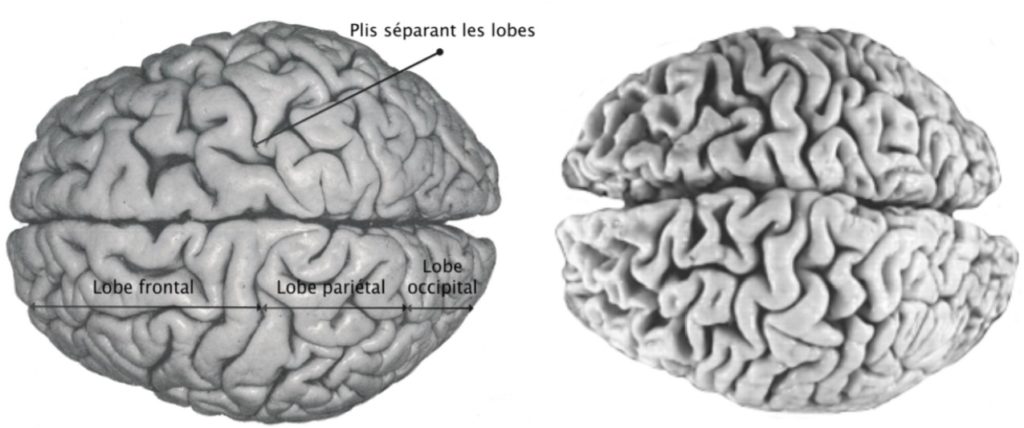
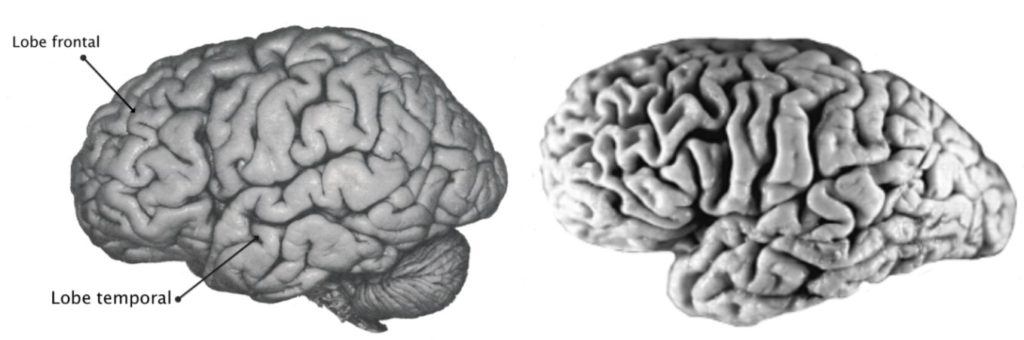
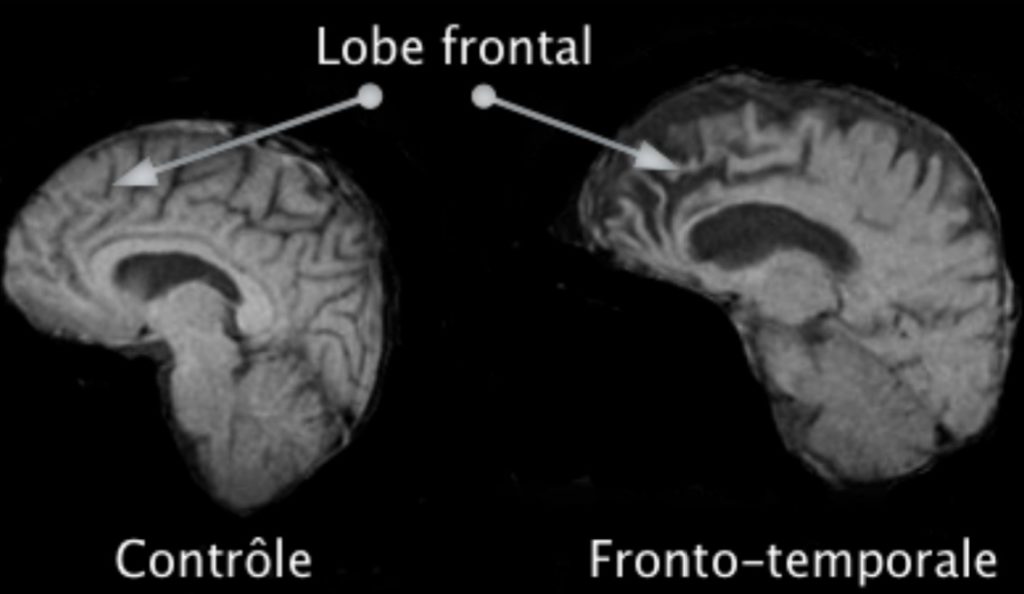
Cerveau humain vu d’en haut provenant d’un sujet sain (à gauche) et d’un patient atteint d’une démence fronto-temporale (à droite). On remarque une atrophie du lobe frontal qui se caractérise par des plis plus marqués. Cerveau humain vu de profil provenant d’un sujet sain (à gauche) et d’un patient atteint d’une DFT (à droite). On remarque une atrophie des lobes frontal et temporal. Coupe latérale d’un cerveau humain provenant d’un sujet contrôle (à gauche) et d’un patient atteint d’une DFT (à droite). On remarque nettement l’atrophie du lobe frontal.
Diagnostic différentiel
La démence fronto-temporale peut être confondue avec de nombreuses autres maladies neuropsychiatriques, surtout au début de la maladie; par exemple la dépression, les troubles bipolaires ou obsessionnels compulsifs), avec une tumeur du lobe frontal, un traumatisme crânien, certaines maladies infectieuses, une démence associé à une pathologie du mouvement ou une démence vasculaire ou un alcoolisme chronique.
La maladie d’Alzheimer se distingue de la démence
fronto-temporale par des troubles précoces de la mémoire et de l’orientation
marqués dès le début de la maladie.
Thérapies
Les médicaments sont prescrits à faibles doses au début du
traitement, avant que celles-ci soient augmentées graduellement en fonction des
possibles effets secondaires.
Antidépresseurs
Les antidépresseurs sont utilisés pour traiter les troubles suivants:
• Anxiété et attaque panique
• Trouble obsessionnel/compulsif
• Agressivité
Les inhibiteurs sélectifs de recapture de la sérotonine sont
les types d’antidépresseurs de choix :
Les antipsychotiques sont prescrits à faibles doses pour réduire l’agressivité, le trouble obsessionnel/compulsif, les comportements irrationnels avec cependant des effets secondaires indésirables : prise de poids, pensées ralenties, risque accru de maladie cardiaque. Les antipsychotiques atypiques sont les types d’antipsychotiques de choix : olanzepine (Zyprexa®), quetiapine (Seroquel® or Ketipinor®),
risperidone
(Risperdal®), ziprasidone (Geodon®), aripiprazole (Abilify®), paliperidone
(Invega®). La mémantine, médicament déjà dans les formes modérée à
sévère de la maladie d’Alzheimer, améliorerait la fonction mnésique des
patients atteints de démence fronto-temporale.
Exercices
Un programme d’entraînement combinant aérobie (marche) et musculation est bénéfique pour le patient (par exemple la pratique d’exercices cardiovasculaires de 30 minutes de 2 à 4 fois par semaine, sous la forme de marche par exemple).
Cas pratique
Madame X âgée de 79 ans est suivie par un neurologue car elle présente des déficits cognitifs légers (score au mini examen de l’état mental de 26 sur 30). Elle est par la suite hospitalisée pour des troubles du comportement avec des périodes d’agitation et des troubles délirants.
Son entourage indique que ces modifications du comportement sont apparues il y a 4 ans, avec parfois des fugues, des achats compulsifs et un manque de convenances sociales.
Le traitement a consisté à lui prescrire un antipsychotique (rispéridone), un régulateur de l’humeur (Valproate) et un antidépresseur.
On note également une réduction de la fluence verbale tandis que les mémoires épisodique et visuo-spatiale apparaissent normales.
La neuroimagerie révèle une diminution de l’activité du cortex frontal et du lobe temporal.
Un diagnostic de démence (dégénérescence) fronto-temporale est posé. Ses performances cognitives se détériorent avec notamment une perte du langage.
Pour rappel, les symptômes de la démence frontotemporale se caractérisent :
Dans les trois quarts des cas par une apathie, une dépression.
Dans une quart des cas par une manie, une désinhibition (perte des convenances sociales), une hypersexualité et des achats compulsifs.
Des déficits cognitifs légers au début de la maladie (pas de perte de mémoire).
Des troubles de l’attention et des fonctions exécutives.
Des troubles alimentaires (boulimie surtout).
Le traitement se limite aux antidépresseurs et aux régulateurs de l’humeur.
La démence frontotemporale liée à un comportement alimentaire anormal
Les patients atteints de démence frontotemporale ont des habitudes alimentaires inappropriées.
Alors que les patients atteints de la variante comportementale mangent excessivement (en particulier des aliments riches en sucre) les patients atteints de démence sémantique (autre forme de démence fronto-temporale) présentent un comportement alimentaire très rigide, en se focalisant parfois sur un aliment précis.
L’imagerie cérébrale a également suggéré que ces habitudes alimentaires sont contrôlées par des réseaux complexes neuronaux plutôt que par une structure particulière du cerveau.
La démence frontotemporale (DFT) est la deuxième cause de démence apparaissant chez les moins de 65 ans. Il existe plusieurs types de DFT : la variante comportementale qui se manifeste notamment par un comportement inapproprié et une incapacité de planifier, alors que la démence sémantique se caractérise par une perte du sens des mots.
« Il est possible que la modification des habitudes alimentaires peuvent avoir un rôle protecteur dans la démence frontotemporale. Il ets nécessaire de savoir si nous pouvons modifier ces comportements alimentaires et si cela apportera une différence », déclare l’auteur principal de l’étude.
49 patients avec trois différents types de démence (19 avec la variante comportemente, 15 souffrant de démence sémantique, et 15 souffrant de la maladie d’Alzheimer) ont participé à l’étude. Leurs habitudes alimentaires ont été comparées à celles de 25 témoins en bonne santé.
Tous les participants ont jeûné pendant la nuit et ont ensuite reçu un petit déjeuner sous la forme d’un buffet. Les chercheurs ont calculé la quantité totale et le type d’aliments consommés.
Les résultats ont montré que tous les patients atteints de la variante comportementale ont consommé plus de calories que les autres participants, avec une moyenne de 1344 calories, comparée à 710 calories pour le groupe Alzheimer, 573 calories pour le groupe démence sémantique et 603 calories pour le contrôle groupe.
« Les patients avec la variante comportementale et qui mangeaient le moins ont même consommé plus de calories que ceux des autres groupes qui ont mangé le plus. »
En revanche, les patients atteints de démence sémantique ont montré un comportement alimentaire rigide, refusant souvent de manger la nourriture proposée.
L’auteur principal (Dr Ahmed) a noté que l’envie de sucre semble être une caractéristique particulière de la variante comportementale de la DFT.
Il est possible que ces patients présentent des changements dans leur métabolisme qui pourraient être à l’origine de la suralimentation.
Les chercheurs ont également étudié les cerveaux des participants (avec la variante comportementale) à l’aide de l’IRM pour rechercher des dysfonctionnements de certaines zones spécifiques du cerveau. Ils ont constaté que la suralimentation est associée à des réseaux complexes du cerveau impliqués dans la récompense, la fonction autonome, et la vision, et non à une structure précise du cerveau.
Source: Rebekah M. Ahmed et coll. Évaluation du comportement alimentaire Perturbation et associés des réseaux de neurones dans la démence frontotemporale. JAMA Neurol. 2016; 73 (3): 282-290.
Les patients avec une démence frontotemporale ont moins d’émotion
Une étude australienne a montré pour la première fois pourquoi des patients souffrant de démence fronto-temporale ont moins d’émotion face à un souvenir. Cela explique pourquoi ils n’éprouvent aucune émotion lorsqu’ils se souviennent d’un événement marquant (ex. un mariage ou un enterrement). Le Professeur Piguet, auteur de l’étude, déclare, « jusqu’à présent, nous savions que des souvenirs émotifs étaient reliés à l’amygdale, une région de cerveau impliquée dans les émotions. Cette étude est la première qui démontrer l’implication d’une autre structure, le cortex orbitofrontal, dans ce processus. » Un autre chercheur du groupe, Fiona Kumfor, soutient que ces résultats aideront les soignants mieux à comprendre pourquoi leurs proches malades peuvent difficilement interagir avec eux.
« Imaginez que vous assistiez au mariage de votre fille, ou que rencontriez votre petit-enfant pour la première fois, mais que cet événement soit aussi mémorable que de faire son épicerie. » dit Dr Kumfor. Source: The orbitofrontal cortex is involved in emotional enhancement of memory: evidence from the dementias. Brain, 2013.
L’électroconvulsivothérapie est une technique consistant à provoquer une convulsion provoquée par une stimulation.
En 1938, deux médecins italiens (Cerletti et Bini) utilisent des stimulations électriques pour provoquer des crises épileptiques sur une patient soufrant de schizophrénie.
Durant les années, l’électroconvulsivothérapie est le principal moyen (avec l’insulinothérapie) pour soulager les patients hospitalisés soufrant d’un trouble mental grave. Il est maintenant appliqué sous anesthésie, contrairement au début.
Pour ce faire, deux électrodes sont placées sur le crâne. cette technique, souvent critiquée par le public et le milieu médical, était souvent utilisée dans le traitement de la dépression avant l’apparition des premiers antidépresseurs en 1957. A partir de l’apparition de la chlorpromazine au milieu des années 50, il perd de l’attractivité et a mauvaise presse.
Il refait surface dans les années 70, notamment grâce à une étude de l’Association américaine de psychiatrie qui établit son rôle bénéfique dans le traitement des troubles de l’humeur grave selon une méthodologie précise.
L’électroconvulsivothérapie de nos jours
Le fait que le patient soit anesthésié évite les fractutes qui étaient provoquées par les fortes contractions musculaires. La décharge électrique est moindre et le patient est placé sous oxygène, permettant une bonne oxygénation du cerveau. Les électrodes sont placées du même côté de la tête.
Efficacité dans les troubles mentaux.
Selon une méta-analyse, l’ECT serait efficace dans la dépression, les phases de manie. Combinée à un antipsychotique, l’ECT est considérée efficace chez les patients souffrant de schizophrénie. Il manque en revanche d’études cliniques dans d’autres types de pathologies : trouble obsessionnel-convulsif ou syndrome parkinsonien.
L’ECT chez les personnes âgées
L’électroconvulsivothérapie (ECT) est un traitement qui peut être particulièrement utile en gérontopsychiatrie, car les personnes âgées sont plutôt résistantes aux traitements médicamenteux contre la dépression.
De plus, les effets secondaires des antidépresseurs ont tendance à augmenter avec l’âge.
L’ECT est efficace dans le traitement de la dépression majeure chez les personnes âgées, avec des taux de rémission plutôt élevés. Les taux de réponse varient entre 60 et 90%.
L’état de santé des patients est évalué (santé cardiovasculaire, pulmonaire, musculosquelettique) afin de déterminer le rapport risques/bénéfices.
Les effets secondaires incluent confusion et troubles mnésiques. Il faur donc déterminer la fréquence des séances à prévoir.
Quels sont les mécanismes d’action de l’ECT ?
On ne connaît pas le mécanisme d’action. Il est possible que l’ECT favorise le transport des neurotransmetteurs, dont la sérotonine, ce qui entraînerait une augmentation de cette dernière dans le cerveau (un phénomène semblabe à cleui provoqué par certains antidépresseurs).
Précautions
Le corps médical doit évaluer les risques et bénéfices chez les patients ayant les maladies ou affections suivantes:
Maladies cardiovasculaires : anévrisme de l’aorte, hypertension, infarctus du myocarde.
Le masitinib (Société pharmaceutique AB Science) a été développé dans le traitement de la maladie d’Alzheimer et de la sclérose latérale amyotrophie (en cours d’étude).
Masitinib est un inhibiteur de tyrosine kinase administré par voie orale qui cible les mastocytes et les macrophages, des cellules importantes pour l’immunité. Sur la base de son mécanisme d’action unique, le masitinib peut être développé dans un grand nombre de pathologies en oncologie, dans les maladies inflammatoires et dans certaines maladies du système nerveux central.
Actualités
Novembre 2021. Suite à une décision de l’agence américaine FDA, AB Science reprend le recrutement des patients atteints de sclérose latérale amyotrophique (SLA), après une suspension en juin 2021.L’étude AB19001 a été autorisée dans 15 pays en Europe, aux États-Unis ainsi que dans d’autres régions.
Avril 2016. une étude de phase 3 impliquant 50000 patients atteints de sclérose latérale amyotrophie rapporte que la combinaison de masitinib et de riluzone (traitement standard) est supérieure à celle du riluzole seul. Les agences de santé européenne (agence européenne du médicament) et américaine (Food and Drug Administration) souhaitent déposer une demande d’autorisation de mise sur le marché du masitinib dans la sclérose latérale amyotrophie (ou maladie de Charcot).
Février 2015. Le Comité Indépendant de Revue des Données a recommandé la poursuite de l’étude de phase 3 du masitinib dans le traitement de la maladie d’Alzheimer.
Il s’agit d’une étude clinique de phase 3 en double aveugle, randomisée, contrôlée par placebo qui vise à évaluer l’efficacité et la tolérance du masitinib chez des patients souffrant d’une forme légère à modérée de la maladie d’Alzheimer, rappelle la société pharmaceutique AB Science.
La durée de traitement est de 24 semaines et le masitinib est donné en complément d’un inhibiteur de cholinestérase (ex Aricept). L’étude a pour objet d’évaluer l’effet du masitinib sur la cognition, l’autonomie et les activités de la vie quotidienne. L’étude doit recruter environ 600 patients.
La recommandation du comité indépendant de revue des données a été formulée après qu’un tiers des patients a été recruté dans l’étude et a atteint la durée de traitement de 24 semaines.
Précédemment, le comité indépendant de revue des données avait toujours recommandé la poursuite de l’étude sur la base des données de tolérance, ce qui signifie qu’il n’y avait pas de problème de tolérance majeur ou inattendu avec le masitinib dans cette population de patients.
Mai 2013. Le laboratoire AB Science débute une étude clinique de phase 3 sur le masitinib dans le traitement de la maladie d’Alzheimer, au stade léger à modéré. 400 patients devraient être recrutés et répartis en 3 groupes :
Un groupe placebo traité depuis au moins six mois par un inhibiteur de cholinestérase (rivastigmine) et/ou de mémantine.
Deux autres groupes traités avec un inhibiteur de cholestérase plus le masitinib à deux doses différentes.
Les fonctions cognitives ainsi que les activités de la vie quotidienne sont évaluées 6 mois plus tard.
Cette étude de phase 3 fait suite à une étude de phase 2, dans laquelle le masitinib était administré comme traitement complémentaire aux traitements de référence. Le laboratoire rappelle que cette étude de phase 2 avait montré « des signes prometteurs sur le retardement du déclin cognitif comparé au placebo, avec un profil de tolérance acceptable ».
Juin 2011. Le laboratoire AB Science SA, spécialisé dans le développement et la commercialisation d’inhibiteurs d’enzymes cellulaires (appelées protéines kinases), annonce la publication des résultats de l’étude de phase 2 du masitinib dans le traitement de la maladie d’Alzheimer.
Le masitinib inhibe les mastocytes, des globules blancs que l’on trouve habituellement dans la moelle osseuse et les ganglions lymphatiques. Les mastocytes participent à la régulation de la perméabilité de la barrière hémato-encéphalique (frontière séparant le système nerveux du système sanguin). Ils sont impliqués dans l’inflammation, un processus pathologique jouant un rôle délétère dans la maladie d’Alzheimer en accélérant la mort neuronale (c’est en tous les cas une hypothèse partagée par certains chercheurs). Selon les dirigeants de AB Science, le masitinib peut avoir un effet sur les symptômes associés à certaines pathologies inflammatoires et du système nerveux central telles que la maladie d’Alzheimer.
Les résultats de cet article intitulé » Masitinib as an adjunct therapy for mild-to-moderate Alzheimer’s disease: a randomised, placebo-controlled phase 2 trial « , sont publiés dans dans la revue Alzheimer’s Research and Therapy. Cette étude de phase 2 randomisée, contrôlée par placebo a été conduite par le Professeur François Piette (Hôpital Charles Foix à Ivry-sur-Seine) et des confrères de 12 sites en France. Trente cinq patients ont été inclus dans cette étude.
Résultats : les patients atteints de maladie d’Alzheimer d’une forme légère à modérée ont reçu du masitinib comme traitement complémentaire à un inhibiteur de cholinestérase et/ou un traitement à la mémantine pendant 24 semaines. Comparé au placebo, une amélioration significative de la fonction cognitive et de la capacité fonctionnelle a été constatée dans le groupe traité avec le masitinib, comme cela a été rendu évident par la réponse soutenue et statistiquement significative dans l’échelle ADAS-Cog. (échelle de mesure de la performance cognitive dans la maladie d’Alzheimer) .
Le Professeur Marc Verny (Chef du service médecine gériatrique de l’hôpital de la Pitié-Salpêtrière à Paris et co-investigateur de l’étude) a commenté la nouvelle : » le masitinib administré comme thérapie complémentaire aux traitements de référence pendant 24 semaines a montré des signes prometteurs dans le retardement du taux de déclin cognitif comparé au placebo, avec un profil de tolérance acceptable. Bien que cette étude soit trop petite pour tirer des conclusions définitives sur l’efficacité du traitement, les résultats de cette étude sont suffisamment probants pour pousser la recherche plus avant dans une phase 3. «
En conséquence, AB Science a lancé un programme de développement clinique dans le traitement de la maladie d’Alzheimer et se prépare activement au lancement d’une étude de phase 3. L’Agence Européenne des Médicaments (EMA) a émis une opinion scientifique favorable pour développer un plan d’étude de phase 3.
Résumé du plan d’étude de phase 3 validé par l’EMA : une étude de phase 3 prospective, multicentrique, randomisée, contrôlée contre placebo, en double aveugle, en groupes parallèles, évaluant l’efficacité et la tolérance du masitinib à 6mg/kg/jour dans le traitement des patients atteints de maladie d’Alzheimer d’une forme légère à modérée sur une période de 24 semaines. Un total de 300 patients sera inclus avec le masitinib administré par voie orale comme thérapie complémentaireau traitement de référence.
La mesure de la réponse reposera sur la proportion des patients présentant : 1. Un effet sur la cognition et la mémoire tel qu’évalué par l’échelle d’évaluation Alzheimer’s Disease Assessment Scale (ADAS-Cog) à la semaine 24. 2. Un effet sur l’autonomie fonctionnelle et la qualité de vie évalué par le questionnaire Alzheimer’s Disease Cooperative Study Activities of Daily Living (ADCS-ADL) à la semaine 24.
Glossaire
Essai clinique en phase I. Première étape de la vie d’un médicament ou d’un traitement. La phase I permet de déterminer la dose qui ne présente aucun danger ainsi que les possibles effets secondaires.
Essai clinique en phase II. Etude qui évalue l’efficacité clinique d’une molécule, et détermine ses éventuels effets secondaires. La phase 2 est subdivisée en deux phases : phases 2a et 2b. Alors que la phase 2a apprécie l’efficacité de la molécule sur un nombre limité (de 100 à 200) de patients, la phase 2b détermine la dose thérapeutique de la molécule sur une plus grande échelle (de 100 à plus de 300 patients). Le développement de la molécule peut s’arrêter durant cette phase si elle ne présente qu’une efficacité modeste et/ou des effets toxiques.
Cet article doit être considéré comme une information et non comme une consultation médicale qui relève, stricto sensu d’une relation individuelle avec un professionnel patenté et selon les règles en vigueur dans le pays. Nous n’assumons aucune responsabilité sur les conséquences liées à l’utilisation de ces renseignements.Pour de plus amples informations sur ce médicament, veuillez contacter votre médecin ou votre pharmacien.
Les arts martiaux ont des bienfaits chez les personnes âgées, que ce soit pour le système cardiovasculaire que pour celles souffrant d’une maladie neurodégénérative (maladies de Parkinson et d’Alzheimer). Ces arts martiaux sont le tai-chi, le qigogn ou le karaté
Maladies cardiovasculaires
Les résultats de l’étude publiée dans le Journal of the American Heart Association, montrent que la pratique d’exercices sportifs chinois tels que le tai-chi (ou tai-chi-chuan)et le qigong pourraient réduire le risque d’AVC de 41 %, et les maladies coronariennes de 22 %. Le tai-chi et le qigong, arts martiaux aux mouvements lents, souples et harmonieux, ne nécessitent pas d’aptitudes physiques particulières.
Le karaté est un des arts martiaux qui pourrait atténuait les symptômes moteurs chez des personnes âgées atteintes de la maladie de Parkinson, selon le témoignage d’un ceinture noire de karaté atteint par cette maladie.
Le karaté m’aide à relaxer, et mes membres s’en ressentent.
Le tai-chi : un art martial qui améliore la qualité de vie des personnes âgées atteints de Parkinson
Un responsable d’une antenne départementale de l’association France Parkinson rapporte le bienfait des cours de tai-chi qui permettent « d’améliorer les gestes classiques de la vie qu’on ne faisait plus correctement ».
C’est en travailler la coordination de ses mouvements que l’on peut en effet améliorer son sens de l’équilibre.
« Tandis que la kiné classique se focalise sur une partie du corps ou un membre, la dimension ici c’est faire prendre conscience de cette dimension globale », poursuit-il.
Cette approche expérimentale, bénéfique dans la pratique, nécessite « la mise en place de quelques études supplémentaires qui va affiner les choses et rendra la méthode encore plus évidente », conclut Paul Woo Fon, le professeur de tai-chi et initiateur de la méthode Xpeo.
«La spécificité du tai-chi Xpeo est de proposer des mouvements qui s’appliquent directement aux activités quotidiennes : marcher, s’asseoir, se lever, se pencher, saisir un objet… Cette pratique facilite ainsi tous les gestes du quotidien et a un impact notable sur la qualité de vie des malades de Parkinson. », déclare la neurologue Dr Fraix, qui traite certains de ces patients.
En 2012, des chercheurs américains ont testé en 2012 l’efficacité du tai-chi-chuan chez 195 patients parkinsoniens au stade léger à modéré, sur une période de six mois.
Les patients ont été répartis en trois groupes : groupe suivant des séances de tai-chi-chuan, groupe suivant un entraînement en résistance, groupe suivant un entraînement en étirement, avec deux sessions d’une heure par semaine.
Résultats : le groupe des personnes ayant pratiqué l’art martial ont obtenu de meilleurs résultats que ceux des deux autres groupes. Le tai-chi-chuan semble réduire plus efficacement les troubles de l’équilibre que les autres types d’entraînement.
Effets du tai-chi sur l’équilibre chez les personnes âgées
Les recherches ont montré que le tai-chi améliore l’équilibre et réduit le risque de chute chez les personnes âgées. Les mécanismes responsables de cette amélioration ne sont pas encore complètement étudiés. Le but d’une étude publiée en 2021 était de déterminer l’efficacité de la pratique du tai-chi dans la perte de poids, les processus cognitifs et les mécanismes moléculaires impliqués dans le contrôle de l’équilibre chez les personnes âgées. Les sujets âgés de 60 à 79 ans ont été randomisés dans un groupe témoin (n = 15) ou dans un groupe de tai-chi (n = 15) pendant une période de 10 semaines pendant la pandémie de COVID-19.
Résultats. 10 semaines de pratique du tai-chi ont conduit à des améliorations de l’équilibre, qui associées à une meilleure attention. La perte de l’équilibre dans les conditions de pandémie était reliée à la prise de poids chez les personnes âgées.
Les arts martiaux et la santé du cerveau
On connaissait les effets positifs du tai-chi-chuan (art martial basé sur la pratique lente d’exercices) sur l’humeur, le stress, la coordination des mouvements, la souplesse, mais aussi la mémoire et la concentration. C’est dans cette optique que cet art martial est souvent proposé à des patients Alzheimer placés en institution.
Des chercheurs sino-américains (Université de Floride du Sud, USA; Université de Fudan, Chine) ont montré que les personnes âgées pratiquant l’art martial tai-chi trois fois par semaine pendant 8 mois auraient un risque moindre de développer une maladie d’Alzheimer.
Ces chercheurs sont arrivés à cette conclusion en observant que le cerveau de ces personnes pratiquant cet art martial était plus gros que celui des individus s’abstenant de le faire. Pour rappel, plusieurs études de neuroimagerie soulignent le lien entre une démence et la baisse anormale du volume (atrophie) du cerveau.
Il faut cependant rappeler que le cerveau s’atrophie chez une personne âgée saine, mais dans une moindre mesure (source : Journal of Alzheimer’s Disease, 2012).